At an international event, the first five minutes decide whether the room becomes an audience or stays a collection of strangers. The usual fixes, a round of introductions or a game in pairs, break down when there are 200 people, a dozen countries and several languages.
The icebreaker that works best at that scale asks one question everyone can answer, in any language, in ten seconds: where are you joining from? Put the answers on a live map on the big screen, and the room sees itself for the first time.
Why do icebreakers matter at an international event?
Because people who know a little about each other work together faster. In a 2006 study by Fullwood and colleagues, pairs who did a ten-minute getting-to-know-you task finished a joint task in 686 seconds on average, against 1,099 seconds for pairs who skipped it. They also used fewer words.
That study involved 48 university students, working in pairs over a video link, so it says nothing directly about a 300-seat plenary. Its explanation still carries over: the icebreaker gave each pair common ground, and common ground made the rest of the conversation easier. An international room starts with less of it than any other.
What makes a good icebreaker for a multicultural audience?
A good icebreaker for a multicultural audience involves everyone at once, needs no shared first language, asks nothing personal and takes a few minutes. It should also leave something visible behind: a picture of the room that the speaker can talk about.
In practice, that rules out a lot:
- A round of introductions takes thirty seconds a person. At 100 people, that is most of an hour.
- Games in pairs depend on a shared language and on people being willing to move around.
- Jokes and personal questions land very differently from one culture to the next. A French regional government guide for facilitators advises an icebreaker that is not too demanding, physically or personally, when people barely know each other.
Which icebreakers work for large international groups?
For a large international group, the icebreakers that work are the ones the whole room answers at once from their seats, and whose result goes up on the screen. A word cloud and a live map both pass that test. Activities that need people to speak one by one, or to stand and move, do not scale.
| Icebreaker | Group size | Language needed | Time | What the room sees |
|---|---|---|---|---|
| Round of introductions | Up to about 15 | Spoken, shared | 30 s a person | Nothing lasting |
| Human map on the floor | 5 to 15 | Little | 10 to 20 min | The group, standing |
| Two truths and a lie | Small groups | Spoken, shared | 10 min or more | Nothing lasting |
| Word cloud: "one word for today" | Any | Written, any language | 2 min | A cloud of words |
| Live map: "where are you from?" | Any | None | 2 min | The whole room on a map |
The human map is the original version of the idea. People stand on an imaginary map of the world laid out on the floor, at the spot where they grew up. SessionLab's description puts it at 5 to 15 participants and 10 to 20 minutes, and it needs a large empty room. It is a lovely exercise for a workshop, and impossible in an auditorium.
Why does a live map work so well?
A live map works because everyone can answer it, nobody has to speak, and the result is interesting for everyone. Each person sees their own country light up, and the speaker gets something real to say: who came furthest, which country is best represented, how many countries are in the room.
We make Ruddud, and its "On the map" slide is built for exactly this. Here is what the big screen showed for a sample room of 128 people:
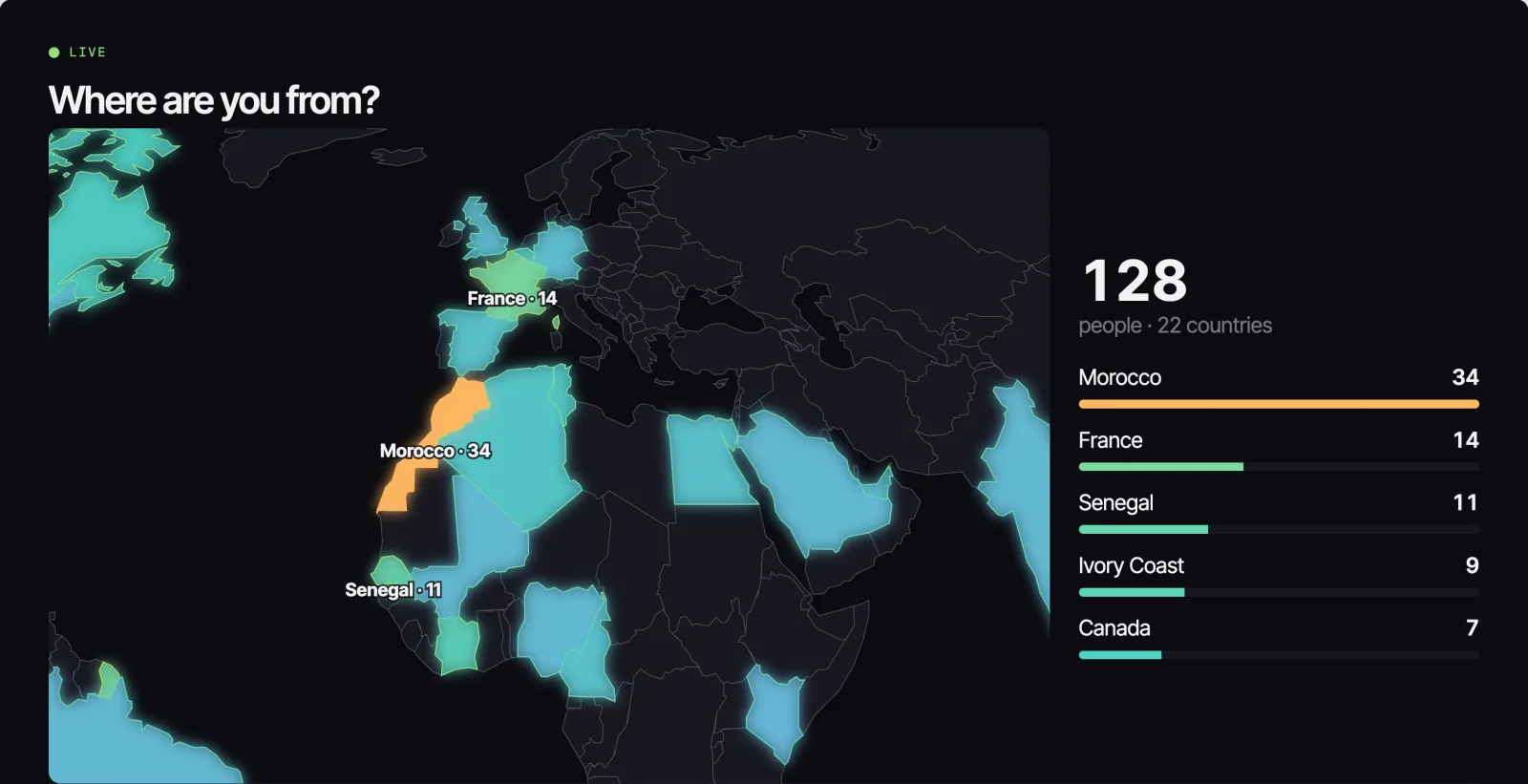
The map fills as people answer. Each country with answers lights up, the busiest one stands out, and a panel gives the total, the number of countries and the top five. Nobody's name appears: the room sees countries and counts, not who said what.
How do you run a live map icebreaker?
Prepare one map question in your presentation, show its code when people sit down, and give the room a minute to answer. Then read the map out loud. Most of the value is in that last step.
With Ruddud, it goes like this:
- Add an "On the map" slide and choose the map: the world, a continent, or one of 49 countries, which then show their regions.
- Choose how people answer. By country (or region on a country map), by city, or by dropping a pin anywhere. Each person can place up to three pins.
- Open the slide. Attendees scan the QR code with their phone camera. No app, no account.
- They tap their country or type it in the search box, then confirm. Place names appear in the language of their phone, right-to-left scripts included.
- Read the result. "Twenty-two countries in this room. The furthest came from Kenya. Morocco, you are a third of us."
On the phone, it looks like this:
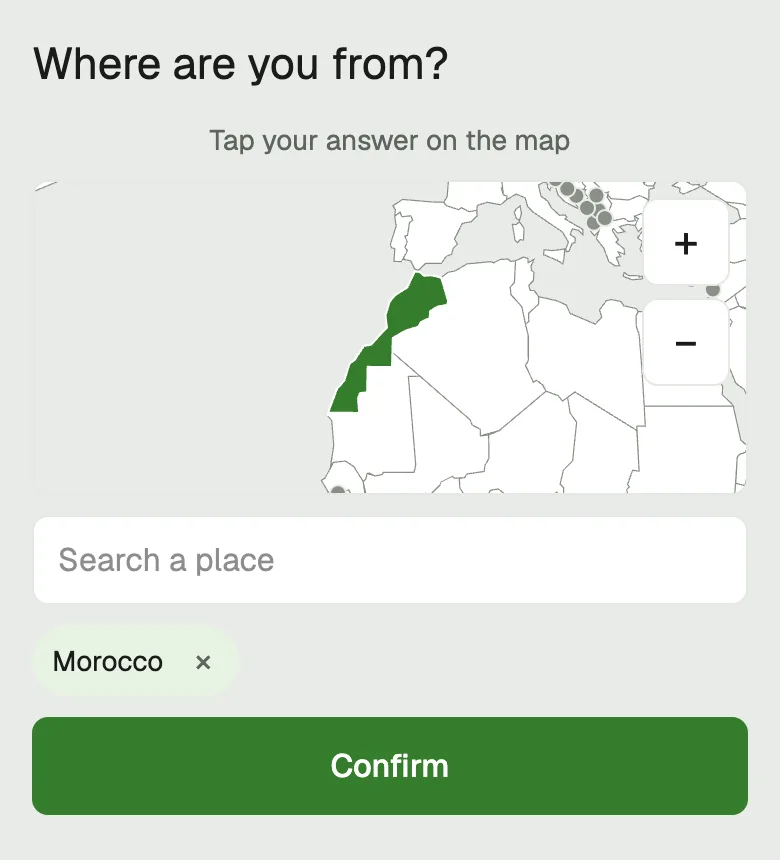
People can zoom in to tap a small country, and they can still move their pin after confirming. Their latest answer is the one that counts.
Is "Where are you from?" a safe question to ask?
Usually, yes, as long as each person answers for themselves and nobody is singled out. The question becomes hurtful when someone else decides the first answer was not good enough. In a 2023 study in BMJ Open, UK medical students described being asked "where are you from?" and having "London" rejected.
That study interviewed 20 students from minority ethnic backgrounds, about their medical training, not about events. The lesson for an icebreaker is simple anyway:
- Ask about the trip, not the origin, if your audience is diverse within each country: "Where did you travel from today?" or "Where do you live?"
- Accept every answer. The person chooses the country; the map does not ask for more.
- Keep names off the screen. Celebrate countries and distances, never an individual.
How do you turn the map into real conversations?
Give people a reason to talk to someone from another country. Once the map is up, ask everyone to find, during the coffee break, one person from a country they have never visited. The map has just shown them that such a person is in the room.
There is a reason this works. In a 2017 paper in the Journal of Personality and Social Psychology, Huang and colleagues found that people who ask more questions, particularly follow-up questions, are better liked by the person they are talking to. People also underestimated this effect. A map gives everyone an easy first question, and an obvious follow-up: "What brought you here from there?"
Try it at your next event
You do not need a conference to test a map icebreaker. Use it at the start of your next meeting, training or webinar, and see how the room responds when it sees itself on screen. The quickest way is the free live map poll: one map question for up to 50 people, with no sign-up. When you want the map inside a whole session, Ruddud's free plan lets you try it once a month, for up to 50 people, with no card required.
Frequently asked questions
How long should an icebreaker last at a conference?
Two to five minutes in a plenary. Long enough for the room to answer and for you to read the result out loud, short enough that it does not eat into the programme. Save longer get-to-know-you games for workshops of fifteen people or fewer.
Does a map icebreaker work for online or hybrid events?
Yes, and it may work better there. Remote attendees answer from their own browser, so the map shows the people in the room and the people watching from home on one screen. That is often the first moment a remote audience feels counted.
What if almost everyone comes from the same country?
Use a map of that country instead of the world, so the answers spread across its regions. A national congress in one country still has people from the north, the south and the capital, and the map makes that visible.
Do participants need to install an app?
Not with Ruddud. They scan the code on the screen and answer in the browser, with no account. That matters at an international event, where people arrive with different phones, roaming data and little patience for a download.